
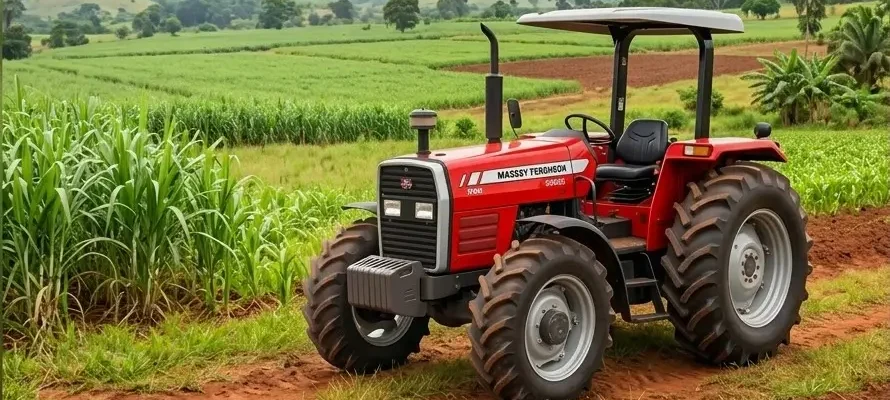
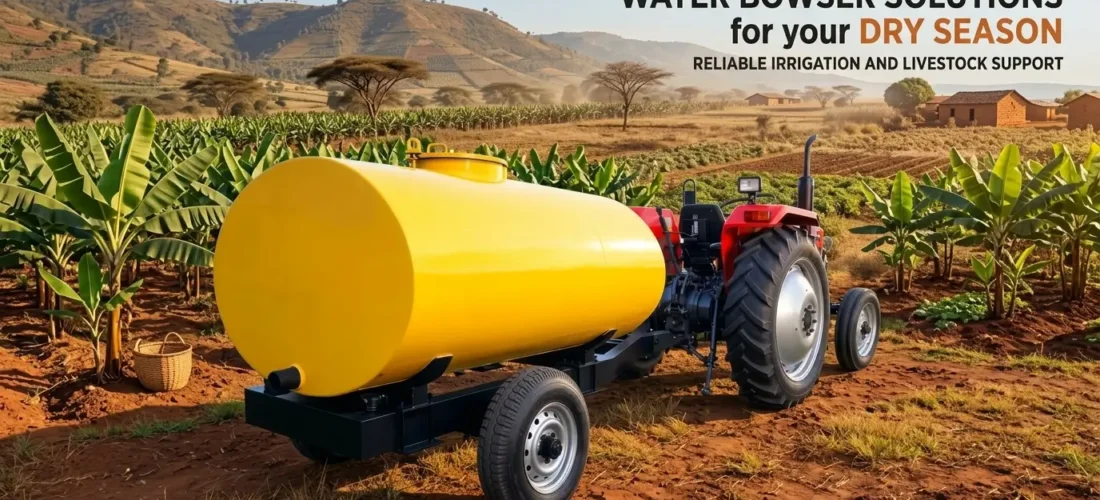
Water bowsers help Ugandan crops survive water shortages by transporting large volumes of water directly to fields and livestock during dry spells, reducing crop failure and protecting farmer incomes. For farmers across Uganda’s drought-prone regions, this tractor-towed implement has become an essential tool for maintaining consistent irrigation when rainfall cannot be relied upon.
What Is a Water Bowser and How Does It Work?
A water bowser is a tank, typically ranging from 500 to 2,000 gallons, that attaches to a tractor and is towed across farmland to deliver water where it’s needed most. Built with an 8″ x 3″ chassis channel for structural strength and an internal baffle plate to stabilise water movement during transit, the bowser reduces spillage and improves balance even on Uganda’s uneven rural roads. It is compatible with tractors of 50 horsepower and above, including Massey Ferguson tractors, making it easy to integrate into an existing farm setup.
Why Do Ugandan Farmers Need Water Bowsers During Droughts?
Uganda’s agricultural regions frequently experience prolonged dry spells that threaten both crop irrigation and livestock survival. Without a reliable way to transport water, farmers risk losing entire harvests or watching herds weaken from dehydration. A water bowser solves this by acting as a mobile water source, allowing farmers to:
- Deliver irrigation water directly to crops during critical growth stages
- Supply drinking water to livestock when natural water sources dry up
- Reach remote fields and villages that lack piped water infrastructure
- Maintain productivity year-round instead of pausing operations during droughts
According to Massey Ferguson Uganda, the bowser’s tractor-towable design makes it highly manoeuvrable across farms, village roads, and uneven terrain, giving farmers flexibility regardless of their land’s layout.
What Are the Benefits of Using a Water Bowser on a Ugandan Farm?
The primary benefit is water security, but the advantages extend further. Water bowsers are a cost-effective investment because they reduce the financial risk of crop failure while requiring minimal maintenance thanks to their robust construction. Farmers running small operations benefit from the 500-gallon option, while larger commercial farms can scale up to 2,000 gallons. This range means the implement suits smallholder farmers and large agricultural operations alike, without requiring a completely separate irrigation system.
Is a Water Bowser a Good Investment for Small-Scale Farmers?
Yes, a water bowser is a worthwhile investment for small-scale farmers because it directly protects yield and livestock health against unpredictable rainfall, which is one of the biggest financial risks in Ugandan agriculture. Even smaller-capacity models pay for themselves by preventing losses during a single severe dry season.
Frequently Asked Questions
How much does a water bowser cost in Uganda?
Pricing varies by capacity and specification. Contact Massey Ferguson Uganda directly for current pricing.
Can a water bowser be used for purposes other than crop irrigation?
Yes, it is also commonly used to supply drinking water to livestock and to transport water to rural households lacking piped access.
What tractor horsepower is needed to tow a water bowser?
A tractor with at least 50 horsepower is required to safely tow and operate a Massey Ferguson water bowser.
Related Posts

Post a Comment